EMS Hand Prop
EMS Hand Prop: Leveraging the Loss of Sense of Agency Caused by Electrical Muscle Stimulation to Make Hands Serve Better as Virtual Objects
Jianhui Yan, Jiesi Zhang, Haoqiang Hua, Wenxuan Wu, Hongnan Lin, Qiwei Xiong, Jianxiu Jin, Lin Shu
International Journal of Human–Computer Studies, Volume 208 (2026), Article 103715
Overview
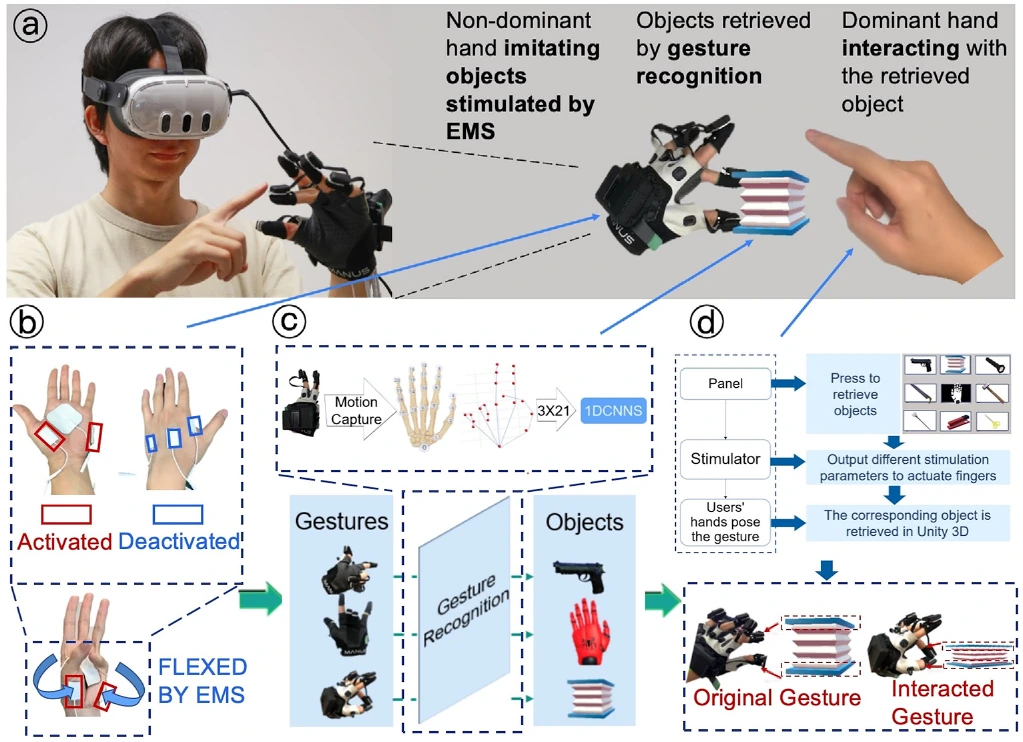
EMS Hand Prop explores how a reduced sense of agency—the feeling of controlling one’s own actions—can help a hand feel more like a virtual object. Instead of treating this effect of electrical muscle stimulation as a drawback, the system uses it to support immersive hand-as-prop interaction in VR.
How it works
- Electrical muscle stimulation actuates fingers of the non-dominant hand into poses associated with eight virtual objects.
- A motion-capture glove and a one-dimensional convolutional neural network recognize the hand gesture and retrieve its corresponding virtual object.
- The dominant hand touches and manipulates the stimulated hand, combining visual feedback with self-haptic contact.
Evaluation & findings
Two user studies with 12 participants compared EMS Hand Prop with non-EMS conditions in object-retrieval and object-interaction tasks. Quantitative and qualitative feedback indicated stronger perceptual transformation of the hand into a virtual object and greater immersion in hand-as-prop interactions.
Takeaway
A loss of perceived control can become a useful design resource when the interaction calls for the hand to behave like an object.
My contributions
- Developed the concept of leveraging EMS-induced loss of agency for hand-as-prop interactions.
- Designed an anatomically guided electrode layout for finger actuation.
- Integrated EMS actuation, gesture recognition, and VR interaction.
Publication
Jianhui Yan, Jiesi Zhang, Haoqiang Hua, Wenxuan Wu, Hongnan Lin, Qiwei Xiong, Jianxiu Jin, Lin Shu. EMS Hand Prop: Leveraging the Loss of Sense of Agency Caused by Electrical Muscle Stimulation to Make Hands Serve Better as Virtual Objects. International Journal of Human–Computer Studies, Volume 208 (2026), Article 103715. DOI: 10.1016/j.ijhcs.2025.103715.